STI Technical Analysis Project 3 Step 4
download here!
http://rcpt.yousendit.com/825906981/7fc23f1d9340f6da4ab8b57cb3011b0c
Thursday, February 25, 2010

Saturday, February 13, 2010
Project 3: Due 28 Feb 11:59pm
Chapter 3: Portfolio Management: Minimum Risk Portfolios
(Start: Feb 8 2010; End: Feb 28 2010)
The most basic and common tool used in the finance profession is the Microsoft Excel spreadsheet. A corporate finance specialist would use it to compute financial statements and proforma; a banker would use it to analyze risk, or tabulate future cash flow illustrations; a trader would use it to model portfolio risk and return; a wealth manager would use it to do financial planning, etc. Thus the mastery of excel directly affects the efficiency of the technical work of any finance professional. In fact, a good command of excel adds a premium to the finance job candidate.
The greatest inadequacy of technical analysis is that it does not tell the investor how much to buy or sell. It only provides buy or sell signals, and at best hints at price momentums and trend changes. However the investor is left clueless about how much of each stock he/she should hold in his/her well diversified portfolio. In fact an over-enthusiastic technical analyst may become tempted to put all eggs in one basket and abandon the benefits of portfolio diversification. Also, technical analysis does not tell the investor the risk and expected return of the investment. Sure enough a strong buy signal may emerge, but how risky is this investment? How much return does the buy signal promise? Technical analysis could not tell.
In 1952, Harry Max Markowitz published a Nobel Prize winning paper in the Journal of Finance , entitled " Portfolio Selection ". This paper brought about such a revolution because for the first time in history, "risk" was quantified. With this missing piece of the building blocks installed, Modern Portfolio Theory was born. The quantification of risk allows the setting up of the concept of Markowitz Efficient Frontier which hypothesizes that for every expected return required from a portfolio (of stocks), there is a unique composition of its component stocks that would yield the minimum risk. Hence this composition must be the most "efficient" in the sense that the portfolio achieves the expected return with the least risk. In other words, all other compositions would be less "efficient" because they can only yield the same expected return but with a higher risk. Any smart investor would hold the efficient composition rather than the less efficient compositions.
This concept, combined with the assumption of the existence of a risk free asset, led to the Capital Asset Pricing Model (CAPM). The CAPM gave rise to the concept of a market portfolio that yields the highest risk premium per risk, or the portfolio that gives the highest Sharpe Ratio . The market portfolio led to the concept of Security Market Line (SML) which dissects the risk of a stock into its idiosyncratic and systematic parts. For the well diversified investor, only the systematic part matters. Subsequently CAPM gave rise to the Arbitrage Pricing Theory, which is the most used theory today.
All these machineries build up to a powerful tool that would guide the fund manager on what stocks to invest in, and how much of each stock to hold. In this exercise, we shall use what we learned in chapter 7 and tutorial 3 to work out the most efficient portfolio composition for investment. Such work typically takes a few weeks in preparing the data and performing analysis runs. However with the PortfolioAnalysis.xls excel spreadsheet programmed for you, it is reduced to less than 15 mins. The PortfolioAnalysis.xls excel spreadsheet will probably be one of the most, if not the most, advanced excel spreadsheet that you will encounter in your undergraduate education. Among other things, it uses the Visual Basic for Applications (VBA) programming and Solver features of excel. In order that these features be activated in your excel, you will need to do a one-time setup procedure in your excel as instructed below.
1) Step 1: Loading the raw price data
Download the file PortfolioAnalysisV00212.xlsm from the workbin and save it into your computer. You shall require Excel 2007 to use this file. At any point if you feel that you have done something wrong and that the file is all messed up, you can download it again and start afresh. Go through the following recorded lecture on how to use the PortfolioAnalysisV00212.xlsm :
https://nus-test.webex.com/nus-test/k2/e.php?AT=RINF&recordingID=4316317 (12:22.9 mins)
You can download the historical price data from: http://sg.finance.yahoo.com/q/hp?s=BN4.SI Just change the "BN4" to your stock's symbol.
Follow the steps in the recorded instruction and load the raw price data of the 4 stocks assigned to you up till Feb 9 2010 . Tabulate the table of average returns, standard deviation, cv and beta in your report. Comment on the numbers you obtained.
2) Step 2: Your current portfolio and the minimum risk portfolio (MRP)
Go to hontrade and check out the Account Balance your portfolio. Key in the latest number of shares held of each of your stocks and the amount of cash your portfolio is holding into the green cells in the Regression worksheet. Report the percentage composition, the expected return, the risk, cv , and the beta of your current portfolio.
Since each of the component stocks has risk, it is inevitable that the portfolio has risk as well. However due to the less than perfect correlation among the component stocks, it is possible to let the stocks diversify each other and yield a low overall portfolio risk. In tutorial 3, you have learned about the global minimum risk portfolio (MRP). The formula that gives you the composition is:
Report on the following:
a) (Working worksheet) The variance-covariance matrix, S .
b) (Working worksheet) The inverse of the variance-covariance matrix, S -1 .
c) (Working worksheet) The matrices, S -1 1, and 1T S -1 1.
d) (Working worksheet) Finally the composition matrix, w0.
e) (Regression worksheet) The percentage composition, the expected return, the risk, cv , and the beta of the minimum risk portfolio.
Then click on the "Correct for round lots" button on the right to obtain the minimum risk portfolio with the restriction that you have to purchase shares in round lots. Report on this minimum risk portfolio given return based on round lots as well. What is the difference between these 2 MRPs?
Comment on the difference between your current portfolio and both the minimum risk portfolio. For example what is the difference in expected return? What is the difference between the risks? Do you think that the difference in expected return justify the difference in risks? What do you think is the difference in percentage composition that leads to the higher risk in your current portfolio? What is the difference in beta? Systematic risk wise, which is the riskier portfolio: your current portfolio or the minimum risk portfolio? What do you learn from this comparison?
3) Step 3: Your current portfolio and the minimum risk portfolio given return (MRPGR)
The comparison in step 2 is not really fair because your current portfolio yields a different expected return than the minimum risk portfolio. Hence you should compare with the minimum risk portfolio that yields about the same expected return as your current portfolio instead.
By clicking on the spin buttons in the Regression worksheet, try to obtain a return as close as possible to your current portfolio return. In tutorial 3, you have learned that the formula for the minimum risk portfolio given required return (MRPGR) composition is:
Report on the following:
a) (Working worksheet) The matrices, A and b.
b) (Working worksheet) The matrices, S -1 AT, A S -1 AT, and (A S -1 AT) -1.
c) (Working worksheet) Finally the composition matrix, w0.
d) (Regression worksheet) The chosen expected return, percentage composition, the expected return, the risk, cv , and the beta of the minimum risk portfolio given return
Then click on the "Correct for round lots" button on the right to obtain the minimum risk portfolio with the restriction that you have to purchase shares in round lots. Report on this minimum risk portfolio given return based on round lots as well. What is the difference between these 2 MRPGRs? Why do you think the round lot MRPGR has higher risk than the non-round lot MRPGR?
Comment on the difference between your current portfolio and both the minimum risk portfolio given return. You can use the same comparison framework as in step 2.
4) Step 4: Planning for your next portfolio composition
Using technical analysis, speculate on the next 1-week price movement of the Straits Times Index (STI). Then set a target expected return for your portfolio accordingly: if you think the STI would rise, then you may set an expected return that yields high risk, if you think the STI would fall, then you may set an expected return that yields low risk, if you think the STI would move sideways, i.e. neither rising nor falling, then you may set a medium expected return. Do you think this above strategy would result in better gains? Why? Give your comments on the above strategy.
Using the Minimum Risk Portfolio given Return table in the Regression worksheet, choose a return that is closest to your target expected return. Call this your target portfolio . Click on the correct for round lots button to get the round lots solution. Report the chosen expected return, percentage composition, the expected return, the risk, cv , and the beta of your round lots target portfolio. Report on the number of shares to buy or sell for each component stock in order to change your current portfolio to the target portfolio, and the transaction cost required. Report your remaining cash balance. (If you result in a negative cash balance, this is alright, just report the negative number.)
Do you think the transaction cost justifies the modification of your current portfolio to the target portfolio? What are your views?
5) Step 5: A very important concept in Portfolio Management is the Efficient Frontier concept. Look at the "EFrontier" worksheet in PortfolioAnalysisV00212.xlsm . Trace the left contour of your figure. You should obtain something like the sample diagram below.

Note the purple line in the diagram. This contour is called the Markowitz Bullet . The top left border of the Markowitz Bullet is called the Efficient Frontier . The Markowitz Bullet and Efficient Frontier that we obtain here are that with the restriction of no short sales. Draw the Markowitz Bullet graph of your portfolio. From your graph, estimate what is the minimum risk (i.e. the sigma or the standard deviation) for a portfolio with return of
a) one-third between the return of the global minimum risk portfolio and the highest return among your stocks.
b) two-third between the return of the global minimum risk portfolio and the highest return among your stocks.
6) Step 6: Discuss your group’s view on the risk and return method of portfolio planning.
a) What does your group learn from this exercise?
b) What do you think are the advantages and disadvantages of using this risk and return method? State some of the difficulties you encountered and some of the strengths you think this method has over technical analysis.
c) How may this exercise change the way you buy or sell stocks in the future?
Notes:
1) You may find that the expected return of your stock is negative. This is alright. It happens when the historical price series is too short, and the stock has gone through more price drops than price rise. Especially for during these times when the stock market is declining, having a negative expected return is not uncommon. If your stock or portfolio has negative expected return, you can just report and work with the negative return as it is, and you can set a negative expected return for your portfolio as well.
2) The minimum risk portfolios are minimum total risk portfolios and not minimum beta portfolios. Hence it is possible that your current portfolio or your stocks have a lower beta than the minimum risk portfolio. When we consider a portfolio, we usually consider it as a standalone rather than a component of another portfolio. Hence it is more appropriate to consider the total risk of the portfolio rather than its beta. Therefore when we want to minimize the risk of the portfolio, we minimize the total risk instead of the beta.
3) The minimum risk portfolio in step 2 does not care about the expected returns of stocks. Hence the return of that minimum risk portfolio could be negative, and could be higher or lower than your current portfolio.
4) Yes it is possible to obtain a negative cash balance after computing the amount of money we need to pay for transaction in step 4. This is alright. Just report the transaction cost needed and the negative balance accordingly.
5) Yes cv can be negative especially if the expected return is negative. If your current portfolio return is negative, you should report the negative value accordingly.
Limit your essay to about 1000 words . Submit your essay in Word format or Acrobat (pdf) format through the link below. Only one member of each group need to submit the report. State the name of your group and your members clearly on the report. The deadline is Feb 28 11:59pm . Please note that the Turnitin.com will automatically check your submission for plagiarism. Plagiarized work is liable for disqualification and disciplinary action by the university.
(Start: Feb 8 2010; End: Feb 28 2010)
The most basic and common tool used in the finance profession is the Microsoft Excel spreadsheet. A corporate finance specialist would use it to compute financial statements and proforma; a banker would use it to analyze risk, or tabulate future cash flow illustrations; a trader would use it to model portfolio risk and return; a wealth manager would use it to do financial planning, etc. Thus the mastery of excel directly affects the efficiency of the technical work of any finance professional. In fact, a good command of excel adds a premium to the finance job candidate.
The greatest inadequacy of technical analysis is that it does not tell the investor how much to buy or sell. It only provides buy or sell signals, and at best hints at price momentums and trend changes. However the investor is left clueless about how much of each stock he/she should hold in his/her well diversified portfolio. In fact an over-enthusiastic technical analyst may become tempted to put all eggs in one basket and abandon the benefits of portfolio diversification. Also, technical analysis does not tell the investor the risk and expected return of the investment. Sure enough a strong buy signal may emerge, but how risky is this investment? How much return does the buy signal promise? Technical analysis could not tell.
In 1952, Harry Max Markowitz published a Nobel Prize winning paper in the Journal of Finance , entitled " Portfolio Selection ". This paper brought about such a revolution because for the first time in history, "risk" was quantified. With this missing piece of the building blocks installed, Modern Portfolio Theory was born. The quantification of risk allows the setting up of the concept of Markowitz Efficient Frontier which hypothesizes that for every expected return required from a portfolio (of stocks), there is a unique composition of its component stocks that would yield the minimum risk. Hence this composition must be the most "efficient" in the sense that the portfolio achieves the expected return with the least risk. In other words, all other compositions would be less "efficient" because they can only yield the same expected return but with a higher risk. Any smart investor would hold the efficient composition rather than the less efficient compositions.
This concept, combined with the assumption of the existence of a risk free asset, led to the Capital Asset Pricing Model (CAPM). The CAPM gave rise to the concept of a market portfolio that yields the highest risk premium per risk, or the portfolio that gives the highest Sharpe Ratio . The market portfolio led to the concept of Security Market Line (SML) which dissects the risk of a stock into its idiosyncratic and systematic parts. For the well diversified investor, only the systematic part matters. Subsequently CAPM gave rise to the Arbitrage Pricing Theory, which is the most used theory today.
All these machineries build up to a powerful tool that would guide the fund manager on what stocks to invest in, and how much of each stock to hold. In this exercise, we shall use what we learned in chapter 7 and tutorial 3 to work out the most efficient portfolio composition for investment. Such work typically takes a few weeks in preparing the data and performing analysis runs. However with the PortfolioAnalysis.xls excel spreadsheet programmed for you, it is reduced to less than 15 mins. The PortfolioAnalysis.xls excel spreadsheet will probably be one of the most, if not the most, advanced excel spreadsheet that you will encounter in your undergraduate education. Among other things, it uses the Visual Basic for Applications (VBA) programming and Solver features of excel. In order that these features be activated in your excel, you will need to do a one-time setup procedure in your excel as instructed below.
1) Step 1: Loading the raw price data
Download the file PortfolioAnalysisV00212.xlsm from the workbin and save it into your computer. You shall require Excel 2007 to use this file. At any point if you feel that you have done something wrong and that the file is all messed up, you can download it again and start afresh. Go through the following recorded lecture on how to use the PortfolioAnalysisV00212.xlsm :
https://nus-test.webex.com/nus-test/k2/e.php?AT=RINF&recordingID=4316317 (12:22.9 mins)
You can download the historical price data from: http://sg.finance.yahoo.com/q/hp?s=BN4.SI Just change the "BN4" to your stock's symbol.
Follow the steps in the recorded instruction and load the raw price data of the 4 stocks assigned to you up till Feb 9 2010 . Tabulate the table of average returns, standard deviation, cv and beta in your report. Comment on the numbers you obtained.
2) Step 2: Your current portfolio and the minimum risk portfolio (MRP)
Go to hontrade and check out the Account Balance your portfolio. Key in the latest number of shares held of each of your stocks and the amount of cash your portfolio is holding into the green cells in the Regression worksheet. Report the percentage composition, the expected return, the risk, cv , and the beta of your current portfolio.
Since each of the component stocks has risk, it is inevitable that the portfolio has risk as well. However due to the less than perfect correlation among the component stocks, it is possible to let the stocks diversify each other and yield a low overall portfolio risk. In tutorial 3, you have learned about the global minimum risk portfolio (MRP). The formula that gives you the composition is:
Report on the following:
a) (Working worksheet) The variance-covariance matrix, S .
b) (Working worksheet) The inverse of the variance-covariance matrix, S -1 .
c) (Working worksheet) The matrices, S -1 1, and 1T S -1 1.
d) (Working worksheet) Finally the composition matrix, w0.
e) (Regression worksheet) The percentage composition, the expected return, the risk, cv , and the beta of the minimum risk portfolio.
Then click on the "Correct for round lots" button on the right to obtain the minimum risk portfolio with the restriction that you have to purchase shares in round lots. Report on this minimum risk portfolio given return based on round lots as well. What is the difference between these 2 MRPs?
Comment on the difference between your current portfolio and both the minimum risk portfolio. For example what is the difference in expected return? What is the difference between the risks? Do you think that the difference in expected return justify the difference in risks? What do you think is the difference in percentage composition that leads to the higher risk in your current portfolio? What is the difference in beta? Systematic risk wise, which is the riskier portfolio: your current portfolio or the minimum risk portfolio? What do you learn from this comparison?
3) Step 3: Your current portfolio and the minimum risk portfolio given return (MRPGR)
The comparison in step 2 is not really fair because your current portfolio yields a different expected return than the minimum risk portfolio. Hence you should compare with the minimum risk portfolio that yields about the same expected return as your current portfolio instead.
By clicking on the spin buttons in the Regression worksheet, try to obtain a return as close as possible to your current portfolio return. In tutorial 3, you have learned that the formula for the minimum risk portfolio given required return (MRPGR) composition is:
Report on the following:
a) (Working worksheet) The matrices, A and b.
b) (Working worksheet) The matrices, S -1 AT, A S -1 AT, and (A S -1 AT) -1.
c) (Working worksheet) Finally the composition matrix, w0.
d) (Regression worksheet) The chosen expected return, percentage composition, the expected return, the risk, cv , and the beta of the minimum risk portfolio given return
Then click on the "Correct for round lots" button on the right to obtain the minimum risk portfolio with the restriction that you have to purchase shares in round lots. Report on this minimum risk portfolio given return based on round lots as well. What is the difference between these 2 MRPGRs? Why do you think the round lot MRPGR has higher risk than the non-round lot MRPGR?
Comment on the difference between your current portfolio and both the minimum risk portfolio given return. You can use the same comparison framework as in step 2.
4) Step 4: Planning for your next portfolio composition
Using technical analysis, speculate on the next 1-week price movement of the Straits Times Index (STI). Then set a target expected return for your portfolio accordingly: if you think the STI would rise, then you may set an expected return that yields high risk, if you think the STI would fall, then you may set an expected return that yields low risk, if you think the STI would move sideways, i.e. neither rising nor falling, then you may set a medium expected return. Do you think this above strategy would result in better gains? Why? Give your comments on the above strategy.
Using the Minimum Risk Portfolio given Return table in the Regression worksheet, choose a return that is closest to your target expected return. Call this your target portfolio . Click on the correct for round lots button to get the round lots solution. Report the chosen expected return, percentage composition, the expected return, the risk, cv , and the beta of your round lots target portfolio. Report on the number of shares to buy or sell for each component stock in order to change your current portfolio to the target portfolio, and the transaction cost required. Report your remaining cash balance. (If you result in a negative cash balance, this is alright, just report the negative number.)
Do you think the transaction cost justifies the modification of your current portfolio to the target portfolio? What are your views?
5) Step 5: A very important concept in Portfolio Management is the Efficient Frontier concept. Look at the "EFrontier" worksheet in PortfolioAnalysisV00212.xlsm . Trace the left contour of your figure. You should obtain something like the sample diagram below.

Note the purple line in the diagram. This contour is called the Markowitz Bullet . The top left border of the Markowitz Bullet is called the Efficient Frontier . The Markowitz Bullet and Efficient Frontier that we obtain here are that with the restriction of no short sales. Draw the Markowitz Bullet graph of your portfolio. From your graph, estimate what is the minimum risk (i.e. the sigma or the standard deviation) for a portfolio with return of
a) one-third between the return of the global minimum risk portfolio and the highest return among your stocks.
b) two-third between the return of the global minimum risk portfolio and the highest return among your stocks.
6) Step 6: Discuss your group’s view on the risk and return method of portfolio planning.
a) What does your group learn from this exercise?
b) What do you think are the advantages and disadvantages of using this risk and return method? State some of the difficulties you encountered and some of the strengths you think this method has over technical analysis.
c) How may this exercise change the way you buy or sell stocks in the future?
Notes:
1) You may find that the expected return of your stock is negative. This is alright. It happens when the historical price series is too short, and the stock has gone through more price drops than price rise. Especially for during these times when the stock market is declining, having a negative expected return is not uncommon. If your stock or portfolio has negative expected return, you can just report and work with the negative return as it is, and you can set a negative expected return for your portfolio as well.
2) The minimum risk portfolios are minimum total risk portfolios and not minimum beta portfolios. Hence it is possible that your current portfolio or your stocks have a lower beta than the minimum risk portfolio. When we consider a portfolio, we usually consider it as a standalone rather than a component of another portfolio. Hence it is more appropriate to consider the total risk of the portfolio rather than its beta. Therefore when we want to minimize the risk of the portfolio, we minimize the total risk instead of the beta.
3) The minimum risk portfolio in step 2 does not care about the expected returns of stocks. Hence the return of that minimum risk portfolio could be negative, and could be higher or lower than your current portfolio.
4) Yes it is possible to obtain a negative cash balance after computing the amount of money we need to pay for transaction in step 4. This is alright. Just report the transaction cost needed and the negative balance accordingly.
5) Yes cv can be negative especially if the expected return is negative. If your current portfolio return is negative, you should report the negative value accordingly.
Limit your essay to about 1000 words . Submit your essay in Word format or Acrobat (pdf) format through the link below. Only one member of each group need to submit the report. State the name of your group and your members clearly on the report. The deadline is Feb 28 11:59pm . Please note that the Turnitin.com will automatically check your submission for plagiarism. Plagiarized work is liable for disqualification and disciplinary action by the university.
Wednesday, February 10, 2010
trading tactic!
drastic times call for drastic measures!
sell and buy sell and buy! hold will die!
any suggestions and insight please feel free to let everyone know!
okay happy cny everyone :)
Project 3 is due 28 Feb 11.59pm
he will upload details by today i guess!
sell and buy sell and buy! hold will die!
any suggestions and insight please feel free to let everyone know!
okay happy cny everyone :)
Project 3 is due 28 Feb 11.59pm
he will upload details by today i guess!
Tuesday, February 2, 2010
Support and Resistance Lines
The support level is a lower line which the stock price rarely breaks. A technican will expect a substantial increase in the demand for a stock when the price reach this level.
A resistance line is a upper level where the technican will expect a large drop in the demand for the stock and a price reversal.
Support and resitance levels can be both horisontal or show a rising trend.
In the figure the support level becomes the new resistance level of the stock price as time pass:

Source: http://www.investopedia.com/university/technical/techanalysis4.asp
A resistance line is a upper level where the technican will expect a large drop in the demand for the stock and a price reversal.
Support and resitance levels can be both horisontal or show a rising trend.
In the figure the support level becomes the new resistance level of the stock price as time pass:
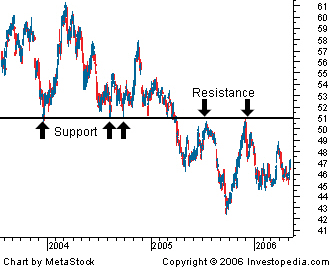
Source: http://www.investopedia.com/university/technical/techanalysis4.asp
How to draw channels
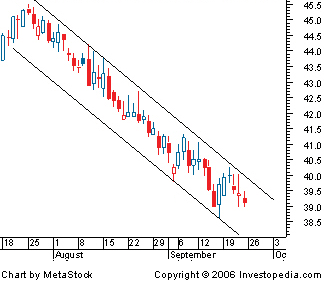
A channel is two parallell trendlines, which are drawn along the lows and the highs. The upper line connects a series of highs and the lower trendline connects a series of lows. The channel can go upwards, downwards or sideways. Note that the upper and lower trendline should be parallell. If the stockprice breaks the channel, the investor can expect a strong movement in the stock price in the direction of the break.
How to draw a trendline
A upward trend is when a high is followed by a higher high and a low by a lower low and opposite for a downward trend. A trend line is drawn at the lows for a upward trend and at the highs for a downward trend.
http://www.investopedia.com/university/technical/techanalysis3.asp
Example of how to draw a upward trendline:
http://www.investopedia.com/university/technical/techanalysis3.asp
Subscribe to:
Comments (Atom)