STI Technical Analysis Project 3 Step 4
download here!
http://rcpt.yousendit.com/825906981/7fc23f1d9340f6da4ab8b57cb3011b0c
Thursday, February 25, 2010

Saturday, February 13, 2010
Project 3: Due 28 Feb 11:59pm
Chapter 3: Portfolio Management: Minimum Risk Portfolios
(Start: Feb 8 2010; End: Feb 28 2010)
The most basic and common tool used in the finance profession is the Microsoft Excel spreadsheet. A corporate finance specialist would use it to compute financial statements and proforma; a banker would use it to analyze risk, or tabulate future cash flow illustrations; a trader would use it to model portfolio risk and return; a wealth manager would use it to do financial planning, etc. Thus the mastery of excel directly affects the efficiency of the technical work of any finance professional. In fact, a good command of excel adds a premium to the finance job candidate.
The greatest inadequacy of technical analysis is that it does not tell the investor how much to buy or sell. It only provides buy or sell signals, and at best hints at price momentums and trend changes. However the investor is left clueless about how much of each stock he/she should hold in his/her well diversified portfolio. In fact an over-enthusiastic technical analyst may become tempted to put all eggs in one basket and abandon the benefits of portfolio diversification. Also, technical analysis does not tell the investor the risk and expected return of the investment. Sure enough a strong buy signal may emerge, but how risky is this investment? How much return does the buy signal promise? Technical analysis could not tell.
In 1952, Harry Max Markowitz published a Nobel Prize winning paper in the Journal of Finance , entitled " Portfolio Selection ". This paper brought about such a revolution because for the first time in history, "risk" was quantified. With this missing piece of the building blocks installed, Modern Portfolio Theory was born. The quantification of risk allows the setting up of the concept of Markowitz Efficient Frontier which hypothesizes that for every expected return required from a portfolio (of stocks), there is a unique composition of its component stocks that would yield the minimum risk. Hence this composition must be the most "efficient" in the sense that the portfolio achieves the expected return with the least risk. In other words, all other compositions would be less "efficient" because they can only yield the same expected return but with a higher risk. Any smart investor would hold the efficient composition rather than the less efficient compositions.
This concept, combined with the assumption of the existence of a risk free asset, led to the Capital Asset Pricing Model (CAPM). The CAPM gave rise to the concept of a market portfolio that yields the highest risk premium per risk, or the portfolio that gives the highest Sharpe Ratio . The market portfolio led to the concept of Security Market Line (SML) which dissects the risk of a stock into its idiosyncratic and systematic parts. For the well diversified investor, only the systematic part matters. Subsequently CAPM gave rise to the Arbitrage Pricing Theory, which is the most used theory today.
All these machineries build up to a powerful tool that would guide the fund manager on what stocks to invest in, and how much of each stock to hold. In this exercise, we shall use what we learned in chapter 7 and tutorial 3 to work out the most efficient portfolio composition for investment. Such work typically takes a few weeks in preparing the data and performing analysis runs. However with the PortfolioAnalysis.xls excel spreadsheet programmed for you, it is reduced to less than 15 mins. The PortfolioAnalysis.xls excel spreadsheet will probably be one of the most, if not the most, advanced excel spreadsheet that you will encounter in your undergraduate education. Among other things, it uses the Visual Basic for Applications (VBA) programming and Solver features of excel. In order that these features be activated in your excel, you will need to do a one-time setup procedure in your excel as instructed below.
1) Step 1: Loading the raw price data
Download the file PortfolioAnalysisV00212.xlsm from the workbin and save it into your computer. You shall require Excel 2007 to use this file. At any point if you feel that you have done something wrong and that the file is all messed up, you can download it again and start afresh. Go through the following recorded lecture on how to use the PortfolioAnalysisV00212.xlsm :
https://nus-test.webex.com/nus-test/k2/e.php?AT=RINF&recordingID=4316317 (12:22.9 mins)
You can download the historical price data from: http://sg.finance.yahoo.com/q/hp?s=BN4.SI Just change the "BN4" to your stock's symbol.
Follow the steps in the recorded instruction and load the raw price data of the 4 stocks assigned to you up till Feb 9 2010 . Tabulate the table of average returns, standard deviation, cv and beta in your report. Comment on the numbers you obtained.
2) Step 2: Your current portfolio and the minimum risk portfolio (MRP)
Go to hontrade and check out the Account Balance your portfolio. Key in the latest number of shares held of each of your stocks and the amount of cash your portfolio is holding into the green cells in the Regression worksheet. Report the percentage composition, the expected return, the risk, cv , and the beta of your current portfolio.
Since each of the component stocks has risk, it is inevitable that the portfolio has risk as well. However due to the less than perfect correlation among the component stocks, it is possible to let the stocks diversify each other and yield a low overall portfolio risk. In tutorial 3, you have learned about the global minimum risk portfolio (MRP). The formula that gives you the composition is:
Report on the following:
a) (Working worksheet) The variance-covariance matrix, S .
b) (Working worksheet) The inverse of the variance-covariance matrix, S -1 .
c) (Working worksheet) The matrices, S -1 1, and 1T S -1 1.
d) (Working worksheet) Finally the composition matrix, w0.
e) (Regression worksheet) The percentage composition, the expected return, the risk, cv , and the beta of the minimum risk portfolio.
Then click on the "Correct for round lots" button on the right to obtain the minimum risk portfolio with the restriction that you have to purchase shares in round lots. Report on this minimum risk portfolio given return based on round lots as well. What is the difference between these 2 MRPs?
Comment on the difference between your current portfolio and both the minimum risk portfolio. For example what is the difference in expected return? What is the difference between the risks? Do you think that the difference in expected return justify the difference in risks? What do you think is the difference in percentage composition that leads to the higher risk in your current portfolio? What is the difference in beta? Systematic risk wise, which is the riskier portfolio: your current portfolio or the minimum risk portfolio? What do you learn from this comparison?
3) Step 3: Your current portfolio and the minimum risk portfolio given return (MRPGR)
The comparison in step 2 is not really fair because your current portfolio yields a different expected return than the minimum risk portfolio. Hence you should compare with the minimum risk portfolio that yields about the same expected return as your current portfolio instead.
By clicking on the spin buttons in the Regression worksheet, try to obtain a return as close as possible to your current portfolio return. In tutorial 3, you have learned that the formula for the minimum risk portfolio given required return (MRPGR) composition is:
Report on the following:
a) (Working worksheet) The matrices, A and b.
b) (Working worksheet) The matrices, S -1 AT, A S -1 AT, and (A S -1 AT) -1.
c) (Working worksheet) Finally the composition matrix, w0.
d) (Regression worksheet) The chosen expected return, percentage composition, the expected return, the risk, cv , and the beta of the minimum risk portfolio given return
Then click on the "Correct for round lots" button on the right to obtain the minimum risk portfolio with the restriction that you have to purchase shares in round lots. Report on this minimum risk portfolio given return based on round lots as well. What is the difference between these 2 MRPGRs? Why do you think the round lot MRPGR has higher risk than the non-round lot MRPGR?
Comment on the difference between your current portfolio and both the minimum risk portfolio given return. You can use the same comparison framework as in step 2.
4) Step 4: Planning for your next portfolio composition
Using technical analysis, speculate on the next 1-week price movement of the Straits Times Index (STI). Then set a target expected return for your portfolio accordingly: if you think the STI would rise, then you may set an expected return that yields high risk, if you think the STI would fall, then you may set an expected return that yields low risk, if you think the STI would move sideways, i.e. neither rising nor falling, then you may set a medium expected return. Do you think this above strategy would result in better gains? Why? Give your comments on the above strategy.
Using the Minimum Risk Portfolio given Return table in the Regression worksheet, choose a return that is closest to your target expected return. Call this your target portfolio . Click on the correct for round lots button to get the round lots solution. Report the chosen expected return, percentage composition, the expected return, the risk, cv , and the beta of your round lots target portfolio. Report on the number of shares to buy or sell for each component stock in order to change your current portfolio to the target portfolio, and the transaction cost required. Report your remaining cash balance. (If you result in a negative cash balance, this is alright, just report the negative number.)
Do you think the transaction cost justifies the modification of your current portfolio to the target portfolio? What are your views?
5) Step 5: A very important concept in Portfolio Management is the Efficient Frontier concept. Look at the "EFrontier" worksheet in PortfolioAnalysisV00212.xlsm . Trace the left contour of your figure. You should obtain something like the sample diagram below.

Note the purple line in the diagram. This contour is called the Markowitz Bullet . The top left border of the Markowitz Bullet is called the Efficient Frontier . The Markowitz Bullet and Efficient Frontier that we obtain here are that with the restriction of no short sales. Draw the Markowitz Bullet graph of your portfolio. From your graph, estimate what is the minimum risk (i.e. the sigma or the standard deviation) for a portfolio with return of
a) one-third between the return of the global minimum risk portfolio and the highest return among your stocks.
b) two-third between the return of the global minimum risk portfolio and the highest return among your stocks.
6) Step 6: Discuss your group’s view on the risk and return method of portfolio planning.
a) What does your group learn from this exercise?
b) What do you think are the advantages and disadvantages of using this risk and return method? State some of the difficulties you encountered and some of the strengths you think this method has over technical analysis.
c) How may this exercise change the way you buy or sell stocks in the future?
Notes:
1) You may find that the expected return of your stock is negative. This is alright. It happens when the historical price series is too short, and the stock has gone through more price drops than price rise. Especially for during these times when the stock market is declining, having a negative expected return is not uncommon. If your stock or portfolio has negative expected return, you can just report and work with the negative return as it is, and you can set a negative expected return for your portfolio as well.
2) The minimum risk portfolios are minimum total risk portfolios and not minimum beta portfolios. Hence it is possible that your current portfolio or your stocks have a lower beta than the minimum risk portfolio. When we consider a portfolio, we usually consider it as a standalone rather than a component of another portfolio. Hence it is more appropriate to consider the total risk of the portfolio rather than its beta. Therefore when we want to minimize the risk of the portfolio, we minimize the total risk instead of the beta.
3) The minimum risk portfolio in step 2 does not care about the expected returns of stocks. Hence the return of that minimum risk portfolio could be negative, and could be higher or lower than your current portfolio.
4) Yes it is possible to obtain a negative cash balance after computing the amount of money we need to pay for transaction in step 4. This is alright. Just report the transaction cost needed and the negative balance accordingly.
5) Yes cv can be negative especially if the expected return is negative. If your current portfolio return is negative, you should report the negative value accordingly.
Limit your essay to about 1000 words . Submit your essay in Word format or Acrobat (pdf) format through the link below. Only one member of each group need to submit the report. State the name of your group and your members clearly on the report. The deadline is Feb 28 11:59pm . Please note that the Turnitin.com will automatically check your submission for plagiarism. Plagiarized work is liable for disqualification and disciplinary action by the university.
(Start: Feb 8 2010; End: Feb 28 2010)
The most basic and common tool used in the finance profession is the Microsoft Excel spreadsheet. A corporate finance specialist would use it to compute financial statements and proforma; a banker would use it to analyze risk, or tabulate future cash flow illustrations; a trader would use it to model portfolio risk and return; a wealth manager would use it to do financial planning, etc. Thus the mastery of excel directly affects the efficiency of the technical work of any finance professional. In fact, a good command of excel adds a premium to the finance job candidate.
The greatest inadequacy of technical analysis is that it does not tell the investor how much to buy or sell. It only provides buy or sell signals, and at best hints at price momentums and trend changes. However the investor is left clueless about how much of each stock he/she should hold in his/her well diversified portfolio. In fact an over-enthusiastic technical analyst may become tempted to put all eggs in one basket and abandon the benefits of portfolio diversification. Also, technical analysis does not tell the investor the risk and expected return of the investment. Sure enough a strong buy signal may emerge, but how risky is this investment? How much return does the buy signal promise? Technical analysis could not tell.
In 1952, Harry Max Markowitz published a Nobel Prize winning paper in the Journal of Finance , entitled " Portfolio Selection ". This paper brought about such a revolution because for the first time in history, "risk" was quantified. With this missing piece of the building blocks installed, Modern Portfolio Theory was born. The quantification of risk allows the setting up of the concept of Markowitz Efficient Frontier which hypothesizes that for every expected return required from a portfolio (of stocks), there is a unique composition of its component stocks that would yield the minimum risk. Hence this composition must be the most "efficient" in the sense that the portfolio achieves the expected return with the least risk. In other words, all other compositions would be less "efficient" because they can only yield the same expected return but with a higher risk. Any smart investor would hold the efficient composition rather than the less efficient compositions.
This concept, combined with the assumption of the existence of a risk free asset, led to the Capital Asset Pricing Model (CAPM). The CAPM gave rise to the concept of a market portfolio that yields the highest risk premium per risk, or the portfolio that gives the highest Sharpe Ratio . The market portfolio led to the concept of Security Market Line (SML) which dissects the risk of a stock into its idiosyncratic and systematic parts. For the well diversified investor, only the systematic part matters. Subsequently CAPM gave rise to the Arbitrage Pricing Theory, which is the most used theory today.
All these machineries build up to a powerful tool that would guide the fund manager on what stocks to invest in, and how much of each stock to hold. In this exercise, we shall use what we learned in chapter 7 and tutorial 3 to work out the most efficient portfolio composition for investment. Such work typically takes a few weeks in preparing the data and performing analysis runs. However with the PortfolioAnalysis.xls excel spreadsheet programmed for you, it is reduced to less than 15 mins. The PortfolioAnalysis.xls excel spreadsheet will probably be one of the most, if not the most, advanced excel spreadsheet that you will encounter in your undergraduate education. Among other things, it uses the Visual Basic for Applications (VBA) programming and Solver features of excel. In order that these features be activated in your excel, you will need to do a one-time setup procedure in your excel as instructed below.
1) Step 1: Loading the raw price data
Download the file PortfolioAnalysisV00212.xlsm from the workbin and save it into your computer. You shall require Excel 2007 to use this file. At any point if you feel that you have done something wrong and that the file is all messed up, you can download it again and start afresh. Go through the following recorded lecture on how to use the PortfolioAnalysisV00212.xlsm :
https://nus-test.webex.com/nus-test/k2/e.php?AT=RINF&recordingID=4316317 (12:22.9 mins)
You can download the historical price data from: http://sg.finance.yahoo.com/q/hp?s=BN4.SI Just change the "BN4" to your stock's symbol.
Follow the steps in the recorded instruction and load the raw price data of the 4 stocks assigned to you up till Feb 9 2010 . Tabulate the table of average returns, standard deviation, cv and beta in your report. Comment on the numbers you obtained.
2) Step 2: Your current portfolio and the minimum risk portfolio (MRP)
Go to hontrade and check out the Account Balance your portfolio. Key in the latest number of shares held of each of your stocks and the amount of cash your portfolio is holding into the green cells in the Regression worksheet. Report the percentage composition, the expected return, the risk, cv , and the beta of your current portfolio.
Since each of the component stocks has risk, it is inevitable that the portfolio has risk as well. However due to the less than perfect correlation among the component stocks, it is possible to let the stocks diversify each other and yield a low overall portfolio risk. In tutorial 3, you have learned about the global minimum risk portfolio (MRP). The formula that gives you the composition is:
Report on the following:
a) (Working worksheet) The variance-covariance matrix, S .
b) (Working worksheet) The inverse of the variance-covariance matrix, S -1 .
c) (Working worksheet) The matrices, S -1 1, and 1T S -1 1.
d) (Working worksheet) Finally the composition matrix, w0.
e) (Regression worksheet) The percentage composition, the expected return, the risk, cv , and the beta of the minimum risk portfolio.
Then click on the "Correct for round lots" button on the right to obtain the minimum risk portfolio with the restriction that you have to purchase shares in round lots. Report on this minimum risk portfolio given return based on round lots as well. What is the difference between these 2 MRPs?
Comment on the difference between your current portfolio and both the minimum risk portfolio. For example what is the difference in expected return? What is the difference between the risks? Do you think that the difference in expected return justify the difference in risks? What do you think is the difference in percentage composition that leads to the higher risk in your current portfolio? What is the difference in beta? Systematic risk wise, which is the riskier portfolio: your current portfolio or the minimum risk portfolio? What do you learn from this comparison?
3) Step 3: Your current portfolio and the minimum risk portfolio given return (MRPGR)
The comparison in step 2 is not really fair because your current portfolio yields a different expected return than the minimum risk portfolio. Hence you should compare with the minimum risk portfolio that yields about the same expected return as your current portfolio instead.
By clicking on the spin buttons in the Regression worksheet, try to obtain a return as close as possible to your current portfolio return. In tutorial 3, you have learned that the formula for the minimum risk portfolio given required return (MRPGR) composition is:
Report on the following:
a) (Working worksheet) The matrices, A and b.
b) (Working worksheet) The matrices, S -1 AT, A S -1 AT, and (A S -1 AT) -1.
c) (Working worksheet) Finally the composition matrix, w0.
d) (Regression worksheet) The chosen expected return, percentage composition, the expected return, the risk, cv , and the beta of the minimum risk portfolio given return
Then click on the "Correct for round lots" button on the right to obtain the minimum risk portfolio with the restriction that you have to purchase shares in round lots. Report on this minimum risk portfolio given return based on round lots as well. What is the difference between these 2 MRPGRs? Why do you think the round lot MRPGR has higher risk than the non-round lot MRPGR?
Comment on the difference between your current portfolio and both the minimum risk portfolio given return. You can use the same comparison framework as in step 2.
4) Step 4: Planning for your next portfolio composition
Using technical analysis, speculate on the next 1-week price movement of the Straits Times Index (STI). Then set a target expected return for your portfolio accordingly: if you think the STI would rise, then you may set an expected return that yields high risk, if you think the STI would fall, then you may set an expected return that yields low risk, if you think the STI would move sideways, i.e. neither rising nor falling, then you may set a medium expected return. Do you think this above strategy would result in better gains? Why? Give your comments on the above strategy.
Using the Minimum Risk Portfolio given Return table in the Regression worksheet, choose a return that is closest to your target expected return. Call this your target portfolio . Click on the correct for round lots button to get the round lots solution. Report the chosen expected return, percentage composition, the expected return, the risk, cv , and the beta of your round lots target portfolio. Report on the number of shares to buy or sell for each component stock in order to change your current portfolio to the target portfolio, and the transaction cost required. Report your remaining cash balance. (If you result in a negative cash balance, this is alright, just report the negative number.)
Do you think the transaction cost justifies the modification of your current portfolio to the target portfolio? What are your views?
5) Step 5: A very important concept in Portfolio Management is the Efficient Frontier concept. Look at the "EFrontier" worksheet in PortfolioAnalysisV00212.xlsm . Trace the left contour of your figure. You should obtain something like the sample diagram below.

Note the purple line in the diagram. This contour is called the Markowitz Bullet . The top left border of the Markowitz Bullet is called the Efficient Frontier . The Markowitz Bullet and Efficient Frontier that we obtain here are that with the restriction of no short sales. Draw the Markowitz Bullet graph of your portfolio. From your graph, estimate what is the minimum risk (i.e. the sigma or the standard deviation) for a portfolio with return of
a) one-third between the return of the global minimum risk portfolio and the highest return among your stocks.
b) two-third between the return of the global minimum risk portfolio and the highest return among your stocks.
6) Step 6: Discuss your group’s view on the risk and return method of portfolio planning.
a) What does your group learn from this exercise?
b) What do you think are the advantages and disadvantages of using this risk and return method? State some of the difficulties you encountered and some of the strengths you think this method has over technical analysis.
c) How may this exercise change the way you buy or sell stocks in the future?
Notes:
1) You may find that the expected return of your stock is negative. This is alright. It happens when the historical price series is too short, and the stock has gone through more price drops than price rise. Especially for during these times when the stock market is declining, having a negative expected return is not uncommon. If your stock or portfolio has negative expected return, you can just report and work with the negative return as it is, and you can set a negative expected return for your portfolio as well.
2) The minimum risk portfolios are minimum total risk portfolios and not minimum beta portfolios. Hence it is possible that your current portfolio or your stocks have a lower beta than the minimum risk portfolio. When we consider a portfolio, we usually consider it as a standalone rather than a component of another portfolio. Hence it is more appropriate to consider the total risk of the portfolio rather than its beta. Therefore when we want to minimize the risk of the portfolio, we minimize the total risk instead of the beta.
3) The minimum risk portfolio in step 2 does not care about the expected returns of stocks. Hence the return of that minimum risk portfolio could be negative, and could be higher or lower than your current portfolio.
4) Yes it is possible to obtain a negative cash balance after computing the amount of money we need to pay for transaction in step 4. This is alright. Just report the transaction cost needed and the negative balance accordingly.
5) Yes cv can be negative especially if the expected return is negative. If your current portfolio return is negative, you should report the negative value accordingly.
Limit your essay to about 1000 words . Submit your essay in Word format or Acrobat (pdf) format through the link below. Only one member of each group need to submit the report. State the name of your group and your members clearly on the report. The deadline is Feb 28 11:59pm . Please note that the Turnitin.com will automatically check your submission for plagiarism. Plagiarized work is liable for disqualification and disciplinary action by the university.
Wednesday, February 10, 2010
trading tactic!
drastic times call for drastic measures!
sell and buy sell and buy! hold will die!
any suggestions and insight please feel free to let everyone know!
okay happy cny everyone :)
Project 3 is due 28 Feb 11.59pm
he will upload details by today i guess!
sell and buy sell and buy! hold will die!
any suggestions and insight please feel free to let everyone know!
okay happy cny everyone :)
Project 3 is due 28 Feb 11.59pm
he will upload details by today i guess!
Tuesday, February 2, 2010
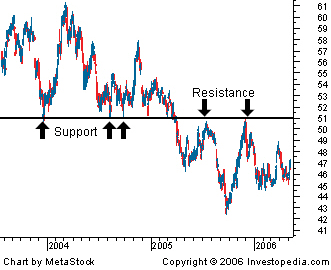
Support and Resistance Lines
The support level is a lower line which the stock price rarely breaks. A technican will expect a substantial increase in the demand for a stock when the price reach this level.
A resistance line is a upper level where the technican will expect a large drop in the demand for the stock and a price reversal.
Support and resitance levels can be both horisontal or show a rising trend.
In the figure the support level becomes the new resistance level of the stock price as time pass:

Source: http://www.investopedia.com/university/technical/techanalysis4.asp
A resistance line is a upper level where the technican will expect a large drop in the demand for the stock and a price reversal.
Support and resitance levels can be both horisontal or show a rising trend.
In the figure the support level becomes the new resistance level of the stock price as time pass:
Source: http://www.investopedia.com/university/technical/techanalysis4.asp
How to draw channels
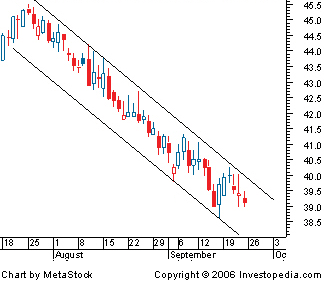
A channel is two parallell trendlines, which are drawn along the lows and the highs. The upper line connects a series of highs and the lower trendline connects a series of lows. The channel can go upwards, downwards or sideways. Note that the upper and lower trendline should be parallell. If the stockprice breaks the channel, the investor can expect a strong movement in the stock price in the direction of the break.
How to draw a trendline
A upward trend is when a high is followed by a higher high and a low by a lower low and opposite for a downward trend. A trend line is drawn at the lows for a upward trend and at the highs for a downward trend.
http://www.investopedia.com/university/technical/techanalysis3.asp
Example of how to draw a upward trendline:
http://www.investopedia.com/university/technical/techanalysis3.asp
Tuesday, January 26, 2010
Project 2: DUE 7 FEB
Chapter 2: Technical Analysis
(Start: Jan 25 2010 ; End: Feb 7 2010 )
Technical analysis receives quite an "undervalued" attention from the well educated finance professionals probably because it committed the crime of challenging the Efficient Market Hypothesis and market equilibrium assumption. According to the weak form market hypothesis, investors cannot make abnormal profits by observing past price trends. Hence if a market is weak form efficient, then its prices would take into account past information so quickly that no investor should be able to squeeze any profit making strategy out of it. However technical analysis suggests otherwise.
Technical analysis is founded on the belief that the market discovers the "correct" price by iterative movements. Since no investor knows the "correct" price, the market prices will fluctuate around the correct price and eventually converges to it. Hence by studying price movements, it is possible to discover the eventual destination of the price movements. The investor who can thus forecast the eventual price, would be able to profit from arbitrage trading. The existing finance theories however dismiss this possibility because they assume that market prices are at equilibrium at all times. Thus up till now, technical analysis is regarded as more of a "superstition" rather than a science. Stock investment gurus such as Warren Buffet claimed that he never used technical analysis. Nonetheless if you read any financial market news or stock analyst reports, you would usually find quite a fair amount of technical analysis in the reports.
Here is an outdated report using technical analysis: http://www.youtube.com/watch?v=tFcpyAhQN2g Look out for the humor/joke at the end of the report :P
Here is another outdate report using technical analysis: http://www.youtube.com/watch?v=wSpMt0kfTIM In this report the presenter interacts with the chart as he speaks.
Note the speed and great familiarity of the experts as they describe their analysis. The use of selective tools to substantiate their conclusions is excellent. This is the best way to present one’s technical analysis.
Enough is said, it is best to experience technical analysis and decide for yourself. In the past you would need to work through all the technical analysis formulas and models in order to do the analysis. Nowadays many web sites would do the technical analysis for you at the click of a button. In this exercise, your group will go through a guided journey through elementary technical analysis. Here are the required steps.
1) Step 1: Go to http://sg.finance.yahoo.com/ Type your stock symbol, appended by ".SI", into the "Enter symbol(s):" box. For example if my stock is Genting International and its symbol is "G13", then I would type "G13.SI" into the box. Make sure that the "Market:" box have "Singapore" chosen. Then click on the "GO" button. If you do this correctly, you would be able to see a screen similar to the following (but it will be your stock instead):

On the left hand menu, click on "Technical Chart". Then on the loaded screen, on the right of "Size:", click on "L" for a large technical analysis chart. If you do this correctly you should see a chart similar to the following (but it would be your stock instead):

The default is a 1 year chart, with the red line a 50 day moving average and the green line a 200 day moving average. Insert the technical analysis chart of each of your 4 companies into your report.
Alternatively you can go directly to this technical chart via the url: http://sg.finance.yahoo.com/q/ta?t=1y&l=on&z=l&q=l&p=m50,m200&a=&c=&s=G13.SI
Change the last 5 characters “G13.SI” to your stock’s ticker plus “.SI”.
Alternatively you can use the Quote.com via the url: http://www.quote.com/global/stocks/chart.action?chartUi.period=D&chartUi.bardensity=HIGH&chartUi.bartype=LINE&chartUi.size=800x550&chartUi.minutes=&s=S53-SES
Change the last 7 characters “S53-SES” to your stock’s ticker plus “-SES”. Actually the Quote.com gives the most beautiful chart among the mentioned alternatives.
Alternatively you can use the charts at the www.sgx.com via the url: http://www.sgx.com/wps/portal/marketplace/mp-en/investor_centre/investor_tools/chart_viewer
Alternatively you can use the charts at the Bloomberg,com via the url: http://www.bloomberg.com/apps/cbuilder?ticker1=GENS%3ASP
Note however that the stock ticker is different in Bloomberg.
2) Step 2: There are many frameworks available to analyze the chart. The most basic are the trend lines, channel, support and resistance lines. In your report, draw trend lines, channel and support and resistance lines for each of your companies, for both a 1 year chart and a 3 month chart. Speculate on what the next support level and the next resistance level are. Note that drawing of such lines is more of an art rather than a science. Hence you may have different lines and numerical conclusions from that of other groups.
3) Step 3: The next most popular methodology in technical analysis involves using simple moving averages. In the chart of Step 1, you have already encountered a chart with moving averages in it. In your report, insert moving averages in the stock chart of each of your companies, including a RSI graph at the bottom of the chart, for 1 year duration and 3 months duration and include them in your report. State clearly the moving average duration you used. Based on the charts state when the most recent moving average buy or sell signal is (you only need to state a buy signal or a sell signal for each company). Speculate, by extending the graphs if necessary, on when the next moving average buy signal or sell signal for each of the companies is. Does the RSI support the buy and/or sell signals?
4) Step 4: A technical analysis indicator closely related to moving averages is called the MACD (Moving Average Convergence Divergence). Describe in your report what is MACD and what are its buy and sell signals. Describe also what is MACD histogram and MACD signal. Insert MACD charts in your report for each company and for 1 year and for 3 months duration. State when the most recent buy or sell signal (you only need to state a buy signal or a sell signal) of each company based on MACD is.
5) Step 5: Pick one more technical analysis indicator that you find at the chart web site. For example you may choose MFI, ROC, Slow Stoch, Fast Stoch, Bollinger Bands (one of my favorites), or Parabolic SAR, etc. Be creative. Then describe in your report what that analysis indicator is intuitively, what are its formulas, and what are its buy and sell signals. Insert the analysis indicator charts in your report for each company and for 1 year and for 3 months duration. State when the most recent buy or sell signal (you only need to state a buy signal or a sell signal) of each company based on that indicator.
6) Step 6: For each of your four stocks, make a conclusion based on your technical analysis above:
a) Should you buy or sell the stock now? If not now, then roughly or intuitively at what price level should you buy or sell?
b) Is the stock currently over-bought or over-sold? Is it currently in a bullish trend, bearish trend or simply drifting sideways?
c) Is there any similarity or differences in (a) and (b) among the four stocks? Can you rationalize (no need to prove) the similarity and differences?
7) Step 7: Discuss your group's view on technical analysis:
a) What does your group learn from this exercise?
b) Is technical analysis an effective tool for timing when to buy or sell stocks and why?
c) How may this exercise change the way you buy or sell stocks in the future?
Limit your essay to about 1000 words. Submit your essay in Word format or Acrobat (pdf) format through the link below. Only one member of each group need to submit the report. State the name of your group and your members clearly on the report. The deadline is Feb 7 11:59pm . Please note that the Turnitin.com will automatically check your submission for plagiarism. Plagiarized work is liable for disqualification and disciplinary action by the university.
Additional notes:
1) You can report step 1 and 2 together since the step 2 charts repeats the step 1 charts.
2) Drawing of lines: after copying the price charts from Yahoo, you can paste them into your favorite graphics program to draw in the line. For example you can use photoshop, paint, Powerpoint, Word, etc to draw your lines.
3) The "next support/resistance line" is the next support line when the current support line is crossed; or the next resistance line when the current resistance line is crossed. Please draw these lines in your chart. The determination of such lines is more of an art, so you will need to use your judgment rather than mathematics to draw these lines.
4) Yes, resistance lines and resistance levels are the same.
5) Support lines and resistance lines need not be parallel.
6) Technically there can be more than 1 channel on the same graph, because each channel represents a different perspective. In this exercise, you only need to give 1 channel for each graph.
7) Trend lines need not be one of the lines making up the channel, though you can use trend lines to be the lines making up the channel.
8) How many moving average lines do you need to insert? Only 2. Try to make one consisting of a small number of days (e.g. 5 days) and one consisting of a large number of days (e.g. 12 days, 30 days, 100 days or 200 days). The number of days is up to you. Note that you do not need to draw these lines yourselves, just use the Yahoo facility that would draw for you.
9) Do not use specialized technical analysis software such as Metastock or ChartNexus to draw the trend lines, support levels, and resistance levels. The objective of this exercise is to give you a hands-on feel of technical analysis, which charting softwares would immune you from. Hence the usage of any chart produced from such specialized trading software would be disqualified.
10) Please constrain yourself in the use of colors. I shall be laser-printing all your reports in black and white. Hence please make sure that your charts and graph lines are distinguishable among each other when printed in black and white. This is a very real constrain in the industry because not only clients laser-print, some of them are color-blind as well.
Saturday, January 23, 2010
Trading highlights
Hi guys
To add on the the post by nikki earlier, I would like to highlight some of the guidelines that our prof has already uploaded that maybe we should take special note of.
The group will need to maintain a weekly journal essay at the end of every week. The essay need only be about 100 words each week journaling the rationale of the week’s buy/sell/hold strategy. All these weekly journal essays will be consolidated into a 900 word essay and be included in the Chapter 5.
So I guess this means that when we buy/sell during each week, we'll have to keep a short description of the rationale for each transaction.
Trading Rules
1. Trading only from 9-5 on weekdays.
2. Transaction cost per trade is CHARGED. The transaction cost includes:
i) 0.275 percent brokerage fees. If this amount is less than $25, then $25 would be charged.
ii) 0.04 percent clearing fees. If this amount is more than $600, then $600 would be charged.
iii) 0.0075 percent SGX access fees.
3. $1,250 penalty per trading day if closing cash balance > 20% of the book value
Made this table:
4. Trading is in round lots--> by the thousands. 1000,2000,3000...

To add on the the post by nikki earlier, I would like to highlight some of the guidelines that our prof has already uploaded that maybe we should take special note of.
The group will need to maintain a weekly journal essay at the end of every week. The essay need only be about 100 words each week journaling the rationale of the week’s buy/sell/hold strategy. All these weekly journal essays will be consolidated into a 900 word essay and be included in the Chapter 5.
So I guess this means that when we buy/sell during each week, we'll have to keep a short description of the rationale for each transaction.
Trading Rules
1. Trading only from 9-5 on weekdays.
2. Transaction cost per trade is CHARGED. The transaction cost includes:
i) 0.275 percent brokerage fees. If this amount is less than $25, then $25 would be charged.
ii) 0.04 percent clearing fees. If this amount is more than $600, then $600 would be charged.
iii) 0.0075 percent SGX access fees.
3. $1,250 penalty per trading day if closing cash balance > 20% of the book value
Made this table:
4. Trading is in round lots--> by the thousands. 1000,2000,3000...

Friday, January 22, 2010
Schedule for Trading
hey guys,
trading has started last week and we have to invest at least 80k by coming Wednesday!
how should we go about doing this trading thing so that each of us can play a part?
shannon and i discussed and thought of taking turns to be in charge of trading for the remaining 9 weeks we have. such as each person will be monitoring and trading for 2 different weeks.
otherwise, we can assign someone to be the 'in charge' person for different weeks but the rest will help to monitor and trade if they see the opportunity, but after completing the transaction, we will inform the 'in charge' of it so that he/she can monitor it for the rest of the week.
how does this sound? or what other suggestions?
do post or comment on this post! :)
trading has started last week and we have to invest at least 80k by coming Wednesday!
how should we go about doing this trading thing so that each of us can play a part?
shannon and i discussed and thought of taking turns to be in charge of trading for the remaining 9 weeks we have. such as each person will be monitoring and trading for 2 different weeks.
otherwise, we can assign someone to be the 'in charge' person for different weeks but the rest will help to monitor and trade if they see the opportunity, but after completing the transaction, we will inform the 'in charge' of it so that he/she can monitor it for the rest of the week.
how does this sound? or what other suggestions?
do post or comment on this post! :)
Tuesday, January 19, 2010
Project 1 - Due 24 Jan 2010
Chapter 1: Understanding the Business
In this discovery project, you shall learn to extract information from company annual reports. Analyzing company annual reports is a very routine function that finance professionals do. A corporate banker analyzes company annual reports to discover the credit-worthiness and value of a firm. A fund manager analyzes company annual reports to discover undervalued and overvalued firms and decide on buy/sell/hold decision of shares. An investment banker analyzes company annual reports to discover good merger and acquisition target firms. A wealth manager analyzes company annual reports to estimate the value of his/her high worth individual (HWI) client’s investment portfolio. Financial industry regulators analyze company annual reports to verify financial practices compliance and detect possible frauds. Shareholders analyze company annual reports to check that the management continue to maximize shareholder wealth. Hence company annual reports are very fundamental source of data for the finance professional.
In this exercise, you shall focus on analyzing qualitative information. Here are the required steps.
1) Step 1: Find the latest available copy of the company annual report of each of the 4 companies assigned to your group. You can either obtain a hard copy annual report or a soft copy version through the internet for the following analysis.
2) Step 2: Concisely but adequately descibe the business of each of the four companies including the following:
a) the mission of the company
b) the products/services of the company
c) the geographical presence of the company
d) the future plans of the company
3) Step 3: Comment on the corporate governance aspects of the board of directors.
4) Step 4: Discuss briefly 4 likely good news and 4 likely bad news that you would look out for which would affect the business performance of the companies (need not affect all 4 companies).
5) Step 5: Briefly discuss your impression on the companies as in are their businesses likely to perform well or poorly in the next 10 weeks.
Notes:
i) you may create sections/subsections in your chapter as you like. Presentation style is up to you.
ii) You can use tables and write in point form in your report. This is according to your presentation style that you would like to adopt. However if your report becomes highly unreadable, then it will be penalized accordingly.
iii) Tables and figures are all included in the word count. In the end, whatever Winword reports as the word count, it will be your essay's word count. Appendices will not be included in the word count, but they may not be read by the marker.
iv) No group is allowed to exceed the deadline.
v) If certain information could not be found in the annual report, you can try other sources such as IPO prospectus and the internet. If still the information cannot be found, then you can just report on what you have found.
Limit your essay to about 1000 words (yes only 1000 words, not negotiable). Submit your essay in Word format or Acrobat (pdf) format through the Plagiarism check. Only one member of each group need to submit the report. State the name of your group and your members (alphabetical order) clearly on the report. The deadline is Jan 24 11:59pm . Late submission may not be accepted. Plagiarized work is liable for disqualification and disclinary action by the university.
Tutorial 1 Presentation
hi all,
Gro has sent out via email the Tut 1 compiled answers for up till qns 7 so far.
we have yet to discuss q 8 and 9 but we have decided to post our answers up here to compare, please do so asap by wed! so that we can collate for presentation the next day!
Gro has sent out via email the Tut 1 compiled answers for up till qns 7 so far.
we have yet to discuss q 8 and 9 but we have decided to post our answers up here to compare, please do so asap by wed! so that we can collate for presentation the next day!
Monday, January 18, 2010
timetable
Hi guys
My timetable is
I’m free on Monday 11-2
Tuesday 2-4
Thursday 12-2
Wednesday and Friday – Free day
Cheers
Shiyuan
My timetable is
I’m free on Monday 11-2
Tuesday 2-4
Thursday 12-2
Wednesday and Friday – Free day
Cheers
Shiyuan
aaron's schedule
hi everyone,
firstly sorry i won't be able to join you guys tmr as i am on internship till this friday. i have asked for half day off on thursday so i can be there for the presentation. i will email out my answers as soon as possible.
my schedule:
mon 9-3
wed 10-2, 4-6
thu 9-3
fri 10-12
aaron
firstly sorry i won't be able to join you guys tmr as i am on internship till this friday. i have asked for half day off on thursday so i can be there for the presentation. i will email out my answers as soon as possible.
my schedule:
mon 9-3
wed 10-2, 4-6
thu 9-3
fri 10-12
aaron
Important info for trading
hey guys,
Click Here to enter the SGX Company's All-in-one Info page
choose from the drop down list for the 4 companies we are assigned:
Gallant
Guoco Leisure
Kep Corp
Sembcorp
a lot of info are found there incl company background, recent news, announcements and also price charts. good for our investment analyses. we need the info for the Chap 1 project as well as our trading.
cheers,
nik
Click Here to enter the SGX Company's All-in-one Info page
choose from the drop down list for the 4 companies we are assigned:
Gallant
Guoco Leisure
Kep Corp
Sembcorp
a lot of info are found there incl company background, recent news, announcements and also price charts. good for our investment analyses. we need the info for the Chap 1 project as well as our trading.
cheers,
nik
meeting!
btw! trading starts today! so i guess we have to discuss about it during tmr's meeting too!
this sunday is the deadline for the Chap 1 Project as well! :(
do reply asap whether you can meet tmr after 3pm thanks!
cheers,
nik
this sunday is the deadline for the Chap 1 Project as well! :(
do reply asap whether you can meet tmr after 3pm thanks!
cheers,
nik
nikki's timetable
hello all,
my timetable is as such:
tue 9-3
wed 9-12
thu 9-3
do inform one another of your timetable so that we can set aside some time for meetings in the subsequent weeks! :D
as for tutorial 1, shall we meet on tuesday to go through and discuss the questions? i am free after 3.
lets all do the questions beforehand so that the meeting can be kept short and sweet
cheers,
nikki
my timetable is as such:
tue 9-3
wed 9-12
thu 9-3
do inform one another of your timetable so that we can set aside some time for meetings in the subsequent weeks! :D
as for tutorial 1, shall we meet on tuesday to go through and discuss the questions? i am free after 3.
lets all do the questions beforehand so that the meeting can be kept short and sweet
cheers,
nikki
contact list
Hi people, here are the names and contact number..:)
Chew Gek Khoon zhou_gk@hotmail.com 96389122
Shannon Ong Shi Yuan shiyuan@nus.edu.sg 98330218
Nikki Yeung Chi Ki ckyeung@nus.edu.sg 91556708
Subscribe to:
Comments (Atom)